A middle-office system for independent asset managers
TAC runs automated processes and reporting including trade monitoring, reconciliation, accounting and compliance for SFC-licensed firms. Qualified people review the exceptions and stand behind the result.
Eight Core Functions, usually covered by a few people.
The SFC's Manager-In-Charge measures took effect on 18 April 2017. Licensed corporations appoint managers responsible for eight Core Functions. A manager reports to the board or the manager responsible for overall management oversight.
A small firm cannot hire eight specialists or buy the systems a large bank runs. The work gets done in spreadsheets and by hand, by people who have other jobs as well. TAC takes on the recurring part of that work.
Take one module or the whole middle office.
Your team can run a module as software, or our team can run it for you. Open a module to see the checks and what you receive.
Reconciliation
Positions, cash and trades matched daily against custodian statements and your books.
Module 01Accounting
Valuations, P&L and client books, worked out from reconciled data.
Module 02Compliance monitoring
Rule checks on all trades and holdings. Each exception goes to a named person.
Module 03Retrocession
Rebates from banks read, tied to the bank's total, allocated to clients and reported.
Module 04Invoice Management
Fee invoices worked out from the shared AUM, approved by a second person and sent in your own layout.
Module 05Risk management
Risk ratings, mandate limits and concentration for senior management, on one page.
Module 06Audit logs
A record of checks, changes and approvals that you can produce for the SFC.
Module 07RM Dashboard
A morning view for each relationship manager of how the news affects their own clients.
Module 08Client Notices
Professional investor notices prepared from the client record, approved and sent each year.
Module 09System Intelligence
Our intelligence framework reads statements, agreements and term sheets, including scanned PDFs and turns them into analytical data.
Pass or fail is decided by written rules, not by a large language model. The same input always gives the same result.
Every read is checked against a second, independent number, such as the total printed on the statement. If the two do not cancel to zero, the file is held.
Our operations and compliance team reviews each exception. Your principals review the final output and sign it.
Each firm has its own server and its own database. One firm's data is not stored with another's.
Each firm's data is always kept within the client's local or cloud environment.
We adjust the service to the way your firm works.
Every source and data point checked and verified
An external asset manager does not hold client money. The records sit with the custodian banks, with the product issuers and in client emails. TAC brings them into one database and checks them before anyone uses them.
Custodian banks, product issuers and client emails.
Statements, trades and client records in one place.
Written rules govern the checks and calculations.
Each transaction is checked. Anything that does not agree goes to a person.
Management reports and audit logs.
Our team reviews the exceptions. Your principals sign the output.
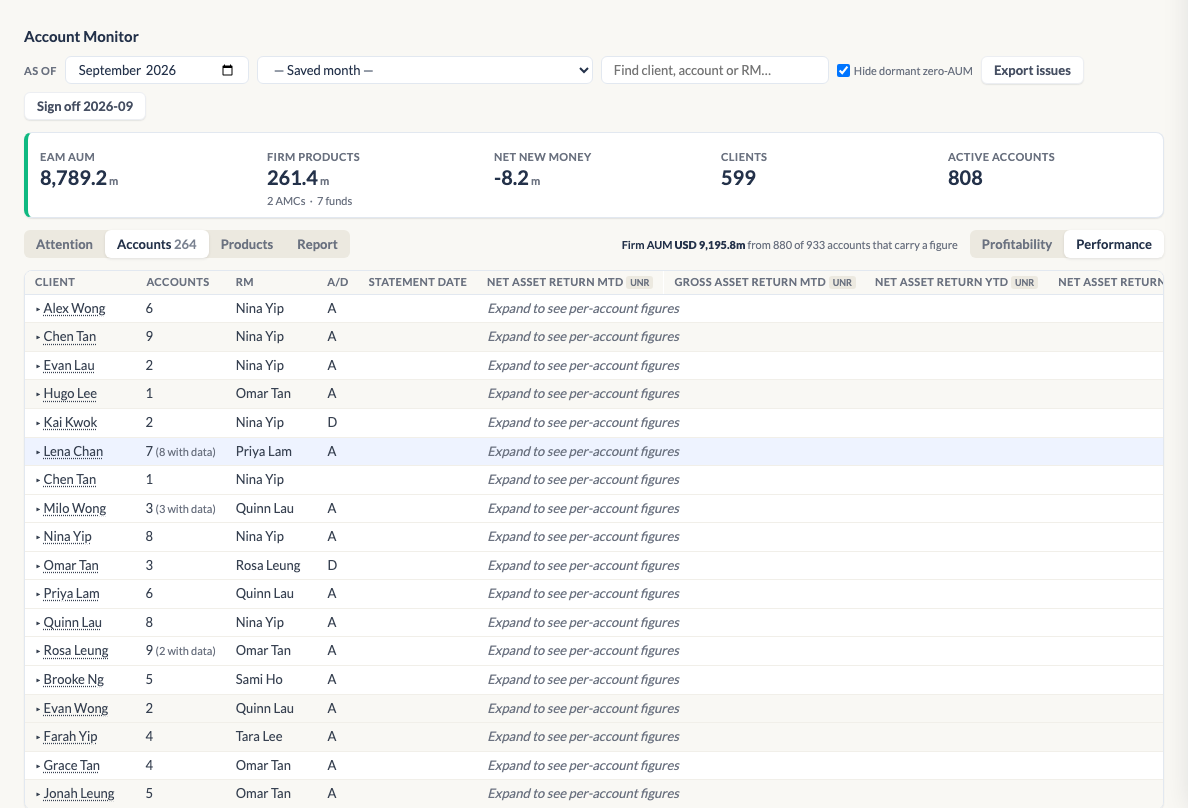
Each account against its limits, using the same AUM figure as the Firm and Risk pages.
Open full screenshot ↗Sample data. Names and figures are made up.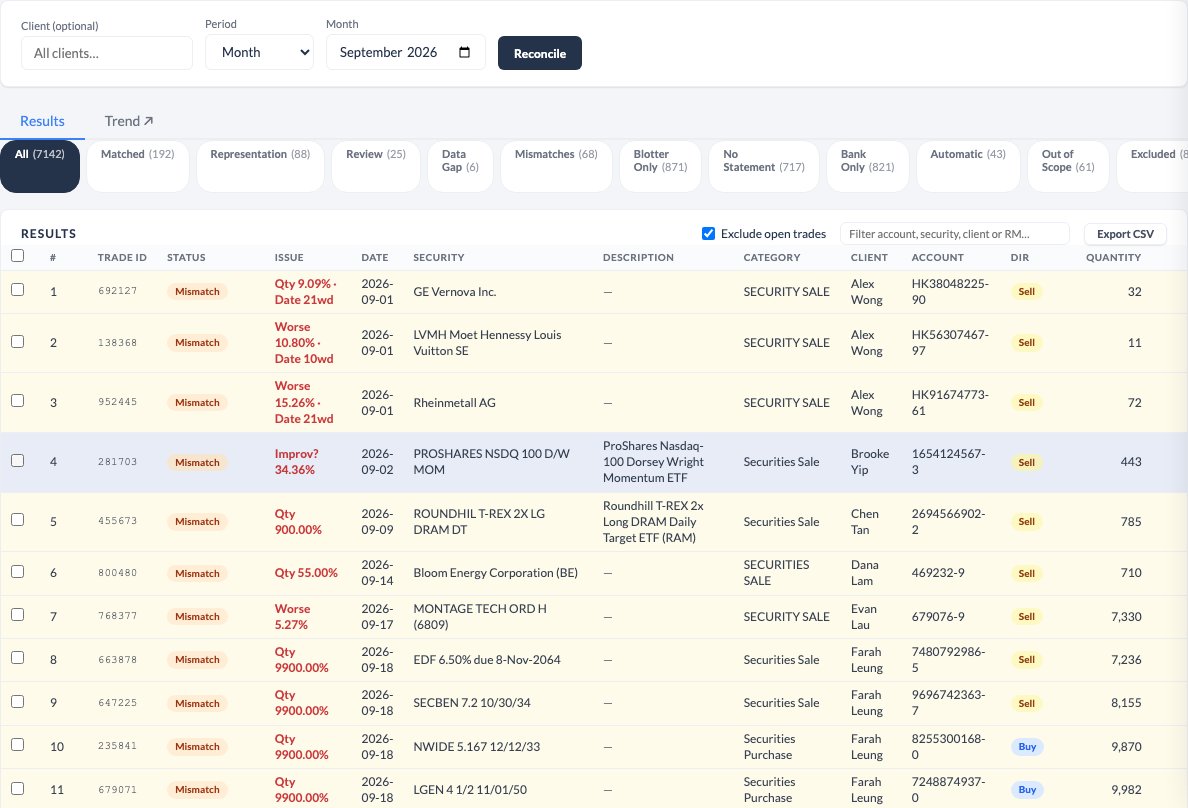
Statement lines beside your books, with each difference shown by amount and by side.
Open full screenshot ↗Sample data. Names and figures are made up.Tried and Tested Against Real Statements.
TAC reads PDF, CSV and XML statements from the banks and brokers below. Adding a bank means writing one new reader and testing it against that bank's real statements, as we did for the rest.
- ACP Securities
- Bank of East Asia
- Bank of Singapore
- BNP Paribas
- CA Indosuez
- CITIC Securities (CSIWM)
- Citco
- DBS Private Bank
- Deutsche Bank
- EFG
- Endowus
- Guotai Junan (GTJAS)
- HSBC
- JPMorgan
- Julius Baer
- KGI
- Leonteq
- LGT
- Standard Chartered
- UBS
- Union Bancaire Privée
- UOB Kay Hian
- Vontobel
By licence type
The rules differ by licence, and so does the set of modules a firm needs.
SFC Type 9 · Asset managers
External asset managers and discretionary managers.
Read more →SFC Type 4 · Advisers
Firms that advise on investments and must show the advice suits the client.
Read more →SFC Type 1 · Brokers and dealers
Firms that deal in securities for clients and keep a trade blotter.
Read more →Family offices
Families with assets at several custodian banks.
Read more →Who does what
The software applies the same checks to each transaction and prepares the outputs. Our operations and compliance team investigates what the checks flag and completes the operating work in your engagement. Your principals stay responsible for the final output.
The checks run on each trade and each holding in scope.
Exceptions are held for review, with the evidence and the reason.
Execution checks cite their regulatory references, including the Code of Conduct, Fund Manager Code of Conduct and Internal Control Guidelines.
We prepare the work and investigate the exceptions. Your principals review the final output and sign it.
Save Costs
Our modules are priced to help save costs.
Reconciliation
Compared with an operations clerkAccounting
Compared with an accountantCompliance monitoring
Compared with a compliance officerIllustrative yearly figures. Your fee is set in the signed engagement. Custom builds are priced on the value they create.
Software only
Your team runs the modules. We maintain the system and the checks.
Operated by TAC
Our team runs the modules and investigates the exceptions. Your principals review and sign the output.
Regulatory Pulse
A monthly digest of circulars, consultations and enforcement notes published by the SFC and highlights for an SFC-licensed firm. Written by the compliance team, not by a model.
Tell us about yourself
Tell us which custodians you use and which parts of the middle office take the most time. We will show you how TAC would handle them, module by module.